
Calgary Commercial Roof Maintenance: The Complete Property Manager Guide

Updated: Jun 1
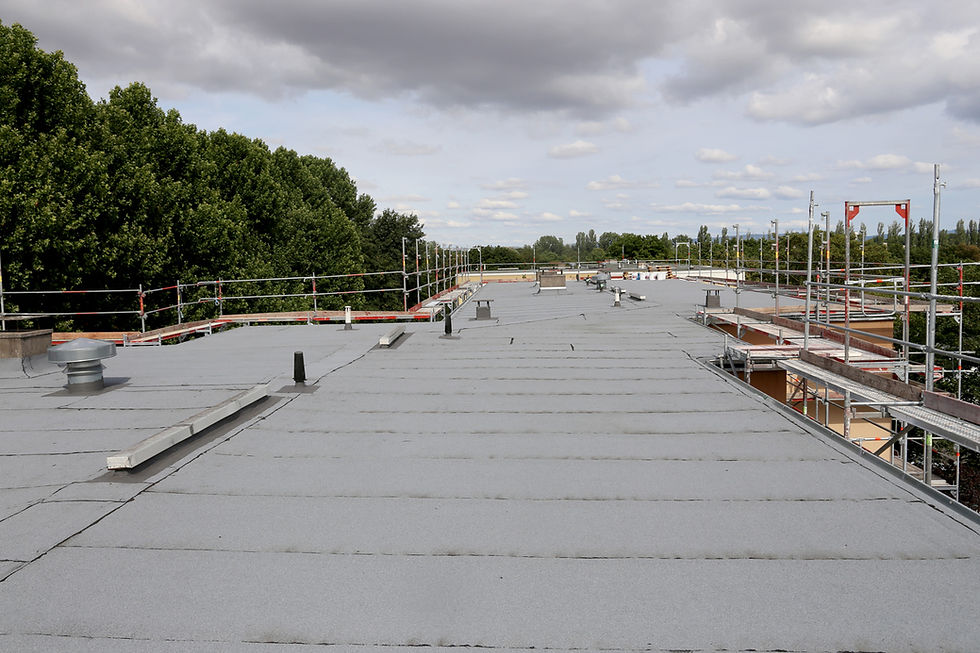
Quick Answer: Calgary commercial roof maintenance is a programmed schedule of inspection, drainage clearing, membrane repair, and seasonal preparation that extends roof life by 5 to 15 years and defers premature replacement. Programs typically run $0.08 to $0.35 per square foot annually, with a quarterly cadence preferred for Calgary's Chinook and hail climate. The documentation produced is now a baseline insurance and lender requirement.
A Calgary commercial roof spends every winter cycling through dozens of freeze-thaw events, every summer absorbing hail risk and high-altitude UV, and every shoulder season under snow load or melt drainage stress. Without a structured maintenance program, the typical building's roof reaches the end of its life 5 to 15 years sooner than its design life, and the replacement event lands as an unplanned capital expense the asset can't absorb. Maintenance changes that math. This guide walks through what a Calgary commercial roof maintenance program includes, how it's priced and scheduled, how it extends asset life, and how the resulting documentation feeds insurance, lender, and capex requirements. The goal is to give you a complete operational and financial picture before signing your next service agreement.
At a Glance
Typical Calgary commercial maintenance cost: $0.08 to $0.35 per square foot annually
Recommended cadence: Quarterly for Calgary climate; twice-yearly minimum
Lifespan extension from programmed maintenance: 5 to 15 years (industry consensus)
Roof leaks repairable on the first visit with active program: ~33%
Calgary design snow load (NBC): 1.7 kPa (35 psf), with drift loading higher
Reactive repair cost premium vs programmed maintenance: Often 200% to 400% over 10 years
Typical contract term: 1, 3, or 5 years; multi-year terms reduce per-visit pricing
Documentation retention recommended by carriers: Minimum 5 years; 10 years preferred at refinance
Key Takeaways
Calgary commercial roof maintenance extends asset life by 5 to 15 years. The compounded capex deferral exceeds the program cost by a wide margin on most assets.
Quarterly cadence is the Calgary standard. The Chinook freeze-thaw count, summer hail risk, and snow load profile justify it on buildings over 20,000 sq ft or roofs over 10 years old.
Comprehensive program pricing runs $0.20 to $0.35 per sq ft annually. Basic programs run $0.08 to $0.15. Multi-property portfolios get bundled pricing.
The documentation produced is now a baseline insurance and lender requirement. Buildings without maintenance records face higher premiums, more restrictive coverage, and lender holdback at refinance.
Reactive-only roofing costs 200% to 400% more than programmed maintenance over 10 years. The driver is interior damage, tenant disruption, and premature replacement, not the repair itself.
Most large commercial buildings end up hybrid. In-house teams handle routine work; outsourced specialists handle membrane repair, coatings, and documentation deliverables.
Why Calgary Commercial Roofs Need More Maintenance Than National Averages
Calgary commercial roofs operate under climate stressors that most national maintenance guides understate. Three factors compound:
Chinook freeze-thaw cycling
A typical Calgary winter produces 30 or more thermal cycling events as Chinooks push temperatures from minus 20 to plus 10 and back within hours. Single-ply seams, modified bitumen flashings, and metal panel sealants all expand and contract through each cycle. Without inspection and repair, micro-fractures become full seam failures by year 8 to 10 on TPO and EPDM systems.
High-altitude UV at 1,045 metres
Calgary sits about 350 metres higher than most Canadian commercial markets. UV intensity is materially higher, which accelerates membrane oxidation, plasticizer migration in PVC and TPO, and surface chalking on SBS. Reflective coatings and topcoats applied during maintenance cycles can recover several years of life.
Hail and wind exposure
The 2020, 2021, and 2024 storms made post-event membrane review a standard maintenance category. Even buildings without dramatic damage often accumulate small membrane impacts that lead to seam failure or vent puncture months later.
The combined effect is that a TPO or EPDM roof rated for 25 to 30 years in a moderate Canadian market often delivers 18 to 22 years in Calgary without maintenance, and 24 to 30 years with a programmed maintenance approach.
What a Commercial Maintenance Program Includes
A complete Calgary commercial roof maintenance program covers six categories of work.
Programs vary by tier, but the comprehensive offering includes:
Scheduled inspections. Quarterly or twice-yearly inspection visits with written reports, photos, and severity ratings.
Drainage maintenance. Internal drain clearing, scupper inspection, downspout flushing, ponding water diagnosis, strainer and dome replacement.
Membrane and seam repair. Small punctures, seam re-welds on TPO, torch-on patches on SBS, EPDM seam re-adhesion. Repairs over a defined size threshold escalate to project-level billing.
Flashing and penetration servicing. Sealant refresh, counterflashing checks, vent and pipe boot replacement, and curb inspection at rooftop units.
Coating and topcoat application. Reflective coatings on TPO and granule-saturated coatings on SBS are applied on a 5 to 10-year cycle to recover surface life.
Snow and ice management. Snow load monitoring during heavy accumulations, ice damming response on parapets and at scuppers, and drainage clearing through winter.
The deliverable from each visit is a written report with photos, severity ratings, recommended action timing, and updated condition data feeding the asset's reserve fund and capex projections.
Recommended Cadence and Seasonal Schedule
Calgary's climate makes quarterly cadence the preferred standard for any building over 20,000 square feet or any roof over 10 years old. A typical Calgary quarterly schedule:
Q1 (January to March)
Snow load and ice damming monitoring. Drainage and scupper clearing as Chinook melt cycles run. Limited rooftop access during sustained cold.
Q2 (April to May)
Full post-winter inspection. Membrane assessment after freeze-thaw stress. Sealant and flashing review. Drainage system flush.
Q3 (July to August)
Mid-season check. Hail event response if a major storm hits. UV-degradation review on TPO and EPDM. Coating application window.
Q4 (October to November)
Pre-winter preparation. Drainage final clear before snow. Sealant refresh. Mechanical curb inspection. Snow guard verification.
Smaller buildings under 20,000 sq ft or newer roofs under 5 years old can run twice-yearly (spring and fall) without significant risk. Buildings over 50,000 sq ft, multi-tenant assets, and roofs over 15 years old should stay quarterly.
Cost Ranges by Building Size and Roof System
Commercial maintenance pricing in Calgary 2026 typically falls into three tiers.
Basic program (twice-yearly inspection, drainage clearing, minor repair):
Small building (5,000 to 15,000 sq ft): $1,200 to $3,500 annually
Mid-size (15,000 to 50,000 sq ft): $3,500 to $9,000 annually
Large (50,000 to 100,000+ sq ft): $9,000 to $20,000+ annually
Comprehensive program (quarterly inspection, full drainage, membrane repairs up to a cap, coatings on cycle):
Small: $3,000 to $6,500
Mid-size: $6,500 to $15,000
Large: $15,000 to $35,000+
Per-square-foot benchmarks:
Basic programs run $0.08 to $0.15 per sq ft. Comprehensive programs run $0.20 to $0.35 per sq ft. Multi-property portfolios often see 10% to 20% discounts off these benchmarks when bundled.
Factors that raise pricing: rooftop mechanical density, parapet complexity, multi-level roof transitions, restricted access requiring lift equipment, and aging membrane systems requiring more repair per visit.
Maintenance vs Reactive Repair: The Economics
The economic case for a maintenance program is the cost of reactive repair, premature replacement, and business interruption.
Industry data consistently shows that reactive-only roofing (no maintenance, repair on failure) costs 200% to 400% more over a 10-year horizon than a programmed maintenance approach. The driver is straightforward: an active leak doesn't just damage the roof. It damages interior finishes, mechanical equipment, tenant goods, and tenant relationships. A $400 seam re-weld caught during a quarterly inspection prevents the $25,000 ceiling, drywall, and floor restoration that follows the same failure six months later.
The maintenance program also captures the documented "first visit repair" rate. According to industry maintenance data, roughly 33% of commercial roof leaks can be repaired on the initial response visit when a maintenance program is in place. Without one, the same leaks often require multiple investigative visits because the building's roof history is unknown.
Premature replacement is the larger economic exposure. A Calgary commercial roof replacement runs $8 to $20 per square foot installed, depending on the system. Deferring that replacement by 5 to 15 years through maintenance materially improves the asset's NOI and capex profile.

Lifecycle Extension Math
The industry consensus on programmed maintenance is 5 to 15 years of additional roof life. The wide range reflects the roof system, building exposure, and program quality.
Typical extension by system in Calgary:
TPO: 5 to 8 years additional with coating cycle
EPDM: 6 to 10 years additional with seam program
SBS modified bitumen: 7 to 12 years additional with topcoat cycle
Metal: 10 to 15 years additional with sealant refresh and coating
PVC: 4 to 7 years additional
The capex math compounds. A $200,000 commercial roof replacement deferred 7 years at a 6% asset discount rate represents approximately $66,000 in net present value savings. Over a 20-year hold period for a typical commercial asset, two maintenance-driven deferrals can easily exceed $150,000 in present-value savings on a single building.
How Maintenance Feeds Insurance, Lender, and Capex Decisions
The documentation a maintenance program produces is increasingly required, not optional.
Insurance carriers
Alberta commercial carriers post-2020 hail routinely require recent roof condition documentation as a condition of policy renewal or claim approval. Carriers may decline coverage on roofs over 15 years old without a recent inspection and maintenance record. Buildings with active maintenance programs and full documentation often see a modest improvement in premium treatment.
Lenders
At acquisition and refinance, commercial mortgage lenders frequently require a property condition assessment that includes recent roof inspection records. A documented maintenance program reduces the holdback or escrow lenders may otherwise require to address roof risk.
Capex planning
The condition data from each maintenance visit feeds the reserve fund study, the 5 to 10-year capital plan, and the immediate-need repair list. Boards and ownership accept capex requests backed by documented condition history at materially higher rates than those backed by a single one-time inspection.
The practical implication: a maintenance program is increasingly the lowest-cost path to multi-stakeholder credibility on roof spend.
Inspection vs Maintenance Programs
The two are related but distinct, and most Calgary commercial assets need both.
Inspections are diagnostic.
They identify conditions and produce recommendations. They don't fix anything.
Maintenance programs are operational.
They include inspection plus the small repairs, drainage clearing, sealant refresh, and coating work that prevent identified conditions from becoming failures.
A reasonable structure for most Calgary commercial assets:
Standalone inspection contract for new acquisitions, refinance events, and warranty disputes
Maintenance program contract for ongoing operational coverage
Maintenance programs typically include the inspection scope, so most assets don't need both contracts active simultaneously. The exception is when a third-party inspection is needed for documentation neutrality (a lender or buyer wants a non-vendor view).
When Maintenance Findings Escalate
Not every finding can be handled within the scope of a maintenance program.
The escalation triggers:
The repair area exceeds the program cap. Most programs include repairs up to a defined size or dollar cap. Beyond that, the work moves to project billing.
Decking exposure or insulation saturation. Once the substrate is compromised, repair becomes a project-level decking and insulation replacement.
System-wide failure pattern. When the same failure mode appears across multiple roof areas, the conversation shifts from maintenance to replacement planning.
Code compliance gap. A code update (Calgary's 2024 expanded ice and water shield requirements affected some commercial low-slope assemblies) triggers retrofit work outside maintenance scope.
Manufacturer warranty action required. If a defect appears within warranty, the manufacturer's authorized repair process takes precedence over routine maintenance.
A well-structured maintenance program flags escalations early and produces the documentation needed to request capex.
Multi-Property and Portfolio Considerations
Property managers handling more than three commercial buildings benefit materially from portfolio-level maintenance contracts.
Portfolio programs typically deliver:
Bundled pricing. Per-sq-ft pricing improves 10% to 20% on portfolios over 200,000 sq ft total.
Unified reporting. Asset condition index across all buildings, capex pipeline ranking, risk-weighted prioritization.
Scheduling efficiency. Maintenance crews are routed to reduce site density per-visit overhead.
Benchmarking. Comparison across buildings of similar age and system reveals outliers.
Single-vendor accountability. One service relationship for all properties simplifies billing, renewal, and dispute resolution.
The trade-off is vendor concentration risk. Portfolio managers usually mitigate this by keeping a secondary qualified vendor pre-qualified for emergency response and backup.
In-House vs Outsourced Maintenance
Larger commercial owners with full-time facilities teams often run hybrid models. In-house teams handle routine drainage clearing, visual checks, and emergency tarping. Outsourced specialists handle membrane repair, coating application, snow load management, and the documentation deliverables.
The split reflects three realities: liability sits with the certified contractor for warranty-relevant work; specialized membrane repair requires manufacturer-trained technicians; and documentation accepted by carriers and lenders generally requires a third-party signature. Buildings with major manufacturer warranties (GAF, IKO, Carlisle, Firestone) often have authorization-network requirements that effectively mandate outsourced repair.
Common Maintenance Mistakes Calgary Property Managers Make
Five patterns appear repeatedly across underperforming maintenance programs. All five are avoidable.
Treating maintenance as a once-yearly visit
A single annual visit catches less than half the conditions a quarterly program identifies in time to repair efficiently. Calgary's climate produces seasonal stressors that don't all surface in the same window.
Accepting vague reports
A maintenance visit without a written report, photos, and severity ratings produces no documentation file. The work may have happened, but the proof for carriers, lenders, and capex committees doesn't exist.
Ignoring drainage between visits. Drains and scuppers can block between scheduled visits, especially after hail or wind events. Buildings without between-visit drainage monitoring may experience preventable ponding water damage.
Failing to track repair completion
Each inspection generates an action list. Without execution tracking, the list grows year over year, recommendations stop being credible, and conditions deteriorate to project scale.
Switching vendors without a records transfer
Mid-warranty vendor changes without proper documentation handoff can void the manufacturer's warranty. The new vendor lacks history, the old vendor's records may be inaccessible, and the file gap shows up at the worst time.
A well-run program produces visible evidence of all five disciplines. If the file is thin, the program is thin.
Maintenance and Manufacturer Warranty Interaction
Major commercial roof manufacturers structure their warranties around two assumptions: certified installation and ongoing maintenance.
Certified installation
The original installer was authorized by the manufacturer for the specific system. This produces the warranty in the first place.
Ongoing maintenance
The warranty assumes the building owner will maintain the roof in reasonable condition.
Specific maintenance requirements vary by manufacturer, but most include:
Periodic inspection (often annual or twice-yearly minimum)
Drainage maintenance prevents ponding of water
Repair of defects within a reasonable time
Use of certified labour for any repair work
Documentation of maintenance and repair activity
Failure to meet these requirements can void warranty coverage. The practical effect: a maintenance program isn't just lifecycle protection. It's warranty preservation.
Some manufacturers offer warranty extensions tied to maintenance program participation. GAF's Diamond Pledge extension, Carlisle's extended warranty programs, and similar offerings from other major manufacturers reward documented maintenance with extended coverage periods. These extensions can add 5 to 10 years to the original warranty terms.
Verify your specific warranty terms before assuming. Maintenance program design should reflect the requirements of the warranty you carry.

Reserve Fund and Capex Integration
For property managers with reserve fund studies or formal capex planning processes, maintenance documentation integrates directly into financial planning.
Reserve fund studies
Common on multi-unit residential and some commercial condo properties. The maintenance inspection findings feed the roof line item of the reserve schedule. Severity ratings (1-year, 3-5 years, 5+ years) translate directly to funding timing. Photo documentation supports the funding justification at owner meetings.
Annual capex submissions
Commercial property owners typically run annual capex review cycles. The year-end condition summary from a maintenance program produces the documented support for capex requests. Boards and asset managers approve documented requests at materially higher rates than undocumented ones.
5 to 10-year capital plans
Longer-horizon planning uses the trend data from multiple years of maintenance reports. The trajectory (improving, stable, declining) informs the planning horizon for major repair or replacement.
Acquisition and disposition planning
Properties moving through the portfolio carry their maintenance history with them. Strong documentation supports the asking price; weak documentation creates buyer concession opportunities.
The maintenance program produces more financial leverage than its line-item cost
suggests when this integration is intentional.
Frequently Asked Questions
Are maintenance programs required by the Alberta code?
No. Maintenance is not code-mandated under the Alberta Building Code. Insurance carriers and lenders increasingly require documented maintenance as a contractual condition, which functionally produces the same outcome for most commercial assets.
What does a maintenance contract usually cover?
Inspection cadence, drainage maintenance, small membrane repairs up to a defined cap, sealant and flashing servicing, and written reporting. Larger repairs, coating application, and snow removal may be included in comprehensive tiers or billed separately in basic tiers. The contract should spell out inclusions and exclusions explicitly.
Are coatings and topcoats included in maintenance programs?
Sometimes. Comprehensive programs often include coatings on a 5 to 10-year cycle. Basic programs typically bill coatings separately as project work. Verify which model applies before signing.
Does maintenance void or preserve manufacturer warranties?
Properly executed maintenance preserves and often extends manufacturer warranties. Improperly executed repairs (wrong sealants, unauthorized membrane patches, untrained labour) can void warranty coverage. Use vendors with the specific manufacturer certification matching your roof system.
Can the program flex with tenant churn or building reconfiguration?
Yes. Well-written contracts allow scope adjustment for tenant fit-up changes, mechanical equipment additions, and rooftop activity changes. The contract should define a change-order process.
Does the program include emergency response?
Most comprehensive programs include a defined emergency response (typically a 24 to 72-hour response on leak calls during business hours, with after-hours response at premium rates). Basic programs may exclude emergency response or include it at hourly billing.
Can I switch vendors mid-contract?
Yes, with notice. Contracts typically include termination clauses requiring 30 to 90 days' notice. Switching mid-warranty period requires careful handoff documentation to preserve the manufacturer's warranty status.

About Angel's Roofing: Angel's Roofing provides Calgary commercial roof maintenance throughout Calgary and surrounding areas, specializing in personalized maintenance plans, quarterly inspection programs, membrane repair, and documentation deliverables for property managers and building owners requiring lifecycle extension and insurance-ready records.
Ready to extend your roof life and defer capex? Angel's Roofing helps Calgary property managers protect their assets with written maintenance reports, drone and thermal imaging capability, GAF, IKO, Malarkey, and Euroshield certified repairs, AARA membership, and 25+ years of Calgary commercial experience.
Contact us today at 403-569-2643 to design a maintenance program for your building or portfolio.
Disclaimer: Roofing involves safety risks; consult licensed professionals for work beyond ground-level visual checks. Costs and specifications provided are estimates based on typical Calgary market conditions and may vary based on specific project requirements and current material pricing.


Comments