
Calgary Eavestroughs & Downspouts: The Complete Homeowner Guide

Updated: Jul 22

Quick Answer: Calgary eavestroughs and downspouts protect your foundation, basement, and landscaping by moving roof water away from the house. Expect to pay $1,200 to $3,500 for a standard residential installation in 2026, with most systems lasting 20 to 30 years. Calgary's hail, ice damming, freeze-thaw cycles, and clay soils make material choice, sizing, and downspout placement more consequential here than in milder climates.
Eavestroughs (the technical name Calgary contractors use for gutters) are easy to ignore until something goes wrong. A small sag becomes a basement leak. A clogged downspout becomes a foundation problem. A few hail dents become a system that drains poorly and pulls the fascia away from the house. Calgary's climate stresses the drainage system in ways most homeowners underestimate, and the decisions you make on material, sizing, downspout placement, and timing affect the rest of the home for the next 20+ years. This guide covers everything from spotting failure signs to choosing aluminum or steel, sizing for Calgary rainfall, managing ice dams, cleaning safely, and deciding whether to bundle eavestroughs into a roof replacement. The goal is a complete mental model before you call for quotes.
At a Glance
Typical Calgary install cost (single-storey, 150 ft): $1,200 to $2,000
Typical Calgary install cost (two-storey, 180 to 220 ft): $2,000 to $3,500
Aluminum 5-inch K-style (most common): $7 to $12 per linear foot installed
Steel and heavy-gauge aluminum upgrades: add $3 to $6 per linear foot
Expected lifespan in Calgary: 20 to 30 years for aluminum, 25 to 40 years for steel
Hail repair frequency: Calgary aluminum gutters often need section replacement after major storms
Recommended downspout spacing: 1 downspout per 30 to 40 linear feet of eavestrough
Downspout extension reach: 4 to 6 feet from foundation, minimum
Calgary cleaning intervals: spring (after snowmelt) and late fall (after leaf drop)
Key Takeaways
Eavestroughs are a foundation-protection system, not a cosmetic finish. Failing gutters in Calgary lead to basement water faster than in most North American markets due to clay soils.
Calgary climate cuts manufacturer-claimed lifespan in half for most materials. Plan replacement around 20 to 30 years for aluminum.
5-inch aluminum K-style is the residential default. Upsize to 6-inch when the roof area, slope, or past overflow history justifies it.
Downspout placement matters more than gutter material. Extensions that move water 4 to 6 feet from the foundation prevent most basement issues.
Ice damming is an attic problem. Eavestrough damage from ice is the symptom; insulation and ventilation are the fix.
Bundle eavestroughs with roof replacement when both are due. Shared access, alignment accuracy, and warranty consolidation typically save 5% to 10%.
What Eavestroughs Actually Do
Eavestroughs catch the water running off your roof and route it through downspouts away from the house. That single function protects four expensive systems:
The foundation. Calgary sits on clay-heavy soil that swells when wet and shrinks when dry. Water pooling near the foundation accelerates cracking, basement seepage, and structural movement.
The basement. Most basement water issues in Calgary trace back to roof drainage. Failed eavestroughs send roof water directly to the foundation, where it works its way through cracks, window wells, and weeping tile.
The landscaping. Concentrated roof runoff erodes flower beds, washes out grading, and kills lawns where water pools.
The exterior cladding. Water cascading down siding, soffit, and fascia accelerates rot, peeling paint, and mould.
A roof without functional eavestroughs is sending hundreds of gallons of water per storm to the worst possible place: the base of your walls. That's why eavestroughs are part of the roof system rather than a cosmetic add-on.
How Long Calgary Eavestroughs Actually Last
Manufacturer literature claims 30 to 50 years for aluminum and longer for steel. Calgary's climate cuts those numbers down.
Aluminum eavestroughs
20 to 30 years before replacement is needed. Hail accelerates this. Aluminum gutters dented by a major storm rarely return to their original drainage capacity even after panel-by-panel repair.
Steel eavestroughs
25 to 40 years. Steel handles hail better than aluminum but rusts at cut edges and where galvanization is compromised. Calgary's freeze-thaw cycles work moisture into those weak points.
Copper
50+ years, but rarely used in Calgary residential areas except on heritage and high-end custom homes. Cost is 4 to 6 times that of aluminum.
Most Calgary homes built in the late 1990s and early 2000s are reaching the natural end-of-life window for their original aluminum eavestroughs now. Combined with three major hail seasons since 2020, replacement demand is high across the city.
Signs Your Eavestroughs Need Replacing
A few isolated failures are repairable. Multiple signs together usually mean full replacement is more cost-effective than ongoing repair.
Visible sagging. Hangers have given out, or the fascia is rotting. Sag in one section is repairable; sag across multiple runs is not.
Rust streaks or pitting (steel) or chalky white oxidation (aluminum). Surface oxidation is cosmetic; through-rust on steel or pitting on aluminum is end-of-life.
Separated seams or end caps. Seams open up as expansion and contraction stresses are repeated at joints. Sealant-repaired seams typically hold 2 to 5 years before re-failing.
Water spilling over the front edge during rain. Either pitch is wrong, the gutter is clogged, or the gutter is too small. If the pitch was correct before and is wrong now, the hangers have shifted.
Peeling paint or rotting fascia. Water has been overshooting or back-flowing onto the fascia for years.
Granule deposits on splash blocks. Heavy granule loss from aging asphalt shingles fills gutters faster and damages downspouts.
A complete cluster article on identifying failure signs is part of this series.

Aluminum vs Steel: The Calgary Decision
Aluminum dominates Calgary residential installations. Steel is a meaningful upgrade for specific situations.
Aluminum (5-inch K-style, 0.027-inch gauge):
Cheapest installed cost
Won't rust
Easier to dent (hail, ladders, falling branches)
Available seamless (continuous run formed on-site)
20- to 30-year lifespan in Calgary
Steel (galvanized or galvalume):
Better hail dent resistance
Heavier (needs robust hangers and solid fascia)
Rusts at cut edges and where coating is compromised
Roughly 30% to 50% higher cost installed
25- to 40-year lifespan if maintained
For most Calgary homes, 5-inch aluminum hits the cost-to-lifespan sweet spot. Steel makes sense for homeowners who've had two hail seasons of aluminum damage in 5 years, or for hail-corridor neighbourhoods where insurance claim history justifies the upgrade. A dedicated material comparison article in this cluster digs into the decision.
Sizing: 5-Inch vs 6-Inch
The 5-inch K-style gutter handles 90% of Calgary residential roof areas without issue. Upsizing to 6-inch makes sense when:
Roof drainage area exceeds about 1,500 square feet per downspout
The roof has steep slopes (greater than 6/12 pitch) that accelerate runoff
The home has long valley sections that concentrate water at specific points
Past performance has shown overflow during Calgary summer storms
A 6-inch gutter carries roughly 40% more water than a 5-inch. The cost premium is 15% to 25% installed. For homes that have overflowed during the 30 mm/hour rainfall that Calgary summer storms produce, the upgrade pays back in foundation protection alone.
Pitch (slope) is the other half of sizing. Eavestroughs need about 1/4 inch of drop per 10 feet of run toward the downspout. Too flat causes pooling; too steep causes overshoot at valleys.
Downspouts: Where the Real Drainage Decisions Happen
A well-sized eavestrough connected to badly placed downspouts creates the basement-water problem the entire system is meant to prevent.
Spacing:
1 downspout per 30 to 40 linear feet of gutter, minimum. Long runs need a downspout at each end plus extras at high-volume valley points.
Discharge distance:
4 to 6 feet from the foundation, minimum. Splash blocks alone are not enough on Calgary clay. Extensions (above-ground or buried) move the water beyond the active foundation zone.
Direction:
Always downhill, away from the house. Negative grading (where the yard slopes back toward the house) is common in older Calgary neighbourhoods and undermines downspout work.
Calgary winter:
Downspouts can freeze solid during Chinook melt-freeze cycles. Ice in the downspout backs up water into the gutter and onto the fascia. Extensions that slope properly and disconnect easily for winter are the most reliable Calgary configuration.
A dedicated downspout placement article in this cluster goes deeper on grading, dry wells, and underground extensions.
Ice Damming: The Calgary Winter Pattern
Ice dams form when heat escaping the attic melts roof snow, the meltwater runs to the cold eaves, and refreezes there. Two things happen to the eavestrough:
Ice builds in the gutter, filling it with frozen water that adds significant weight and stress on the hangers.
Meltwater backs up under the shingles above the ice, eventually finding its way into the soffit and behind the gutter.
Calgary ice dam damage to eavestroughs is one of the most common winter calls. Symptoms include gutters pulling away from the fascia, downspouts cracked or split by ice expansion, and fascia rot where water has been infiltrating for multiple winters.
The fix is not in the gutter, it's in the attic. Adequate insulation (R-50+ in Calgary) and proper attic ventilation prevent the warm-roof condition that creates ice dams in the first place. Heat cables in the gutter are a symptom-management tool, not a solution. The ice damming cluster article explains the full prevention sequence.
Gutter Guards: Worth Considering, Not a Silver Bullet
Gutter guards reduce debris in the gutter, but don't eliminate cleaning entirely. The honest verdict for Calgary:
Micro-mesh guards (the premium tier) reduce cleaning to once every 2 to 3 years for most homes. They cost $8 to $15 per linear foot installed.
Reverse-curve guards work well on standard pitches but can overshoot during heavy rainfall.
Foam inserts are the cheapest option, but they trap fine debris and need replacement every 5 to 7 years.
Brush guards are budget-tier and largely ineffective in Calgary's mixed-debris environment.
Guards do not stop ice damming. Some types can make ice removal harder. Guards make sense for two-storey homes where ladder safety is a real concern and on properties with significant tree coverage.
Cleaning: When and How
Calgary's leaf drop runs late September through early November, with most cleaning happening in October. A spring pass after snowmelt clears any debris that blew in over winter.
Twice-yearly cleaning is the Calgary standard. Properties with significant tree coverage (mature elms, poplars, spruce) benefit from a mid-summer pass after the seed and catkin drop.
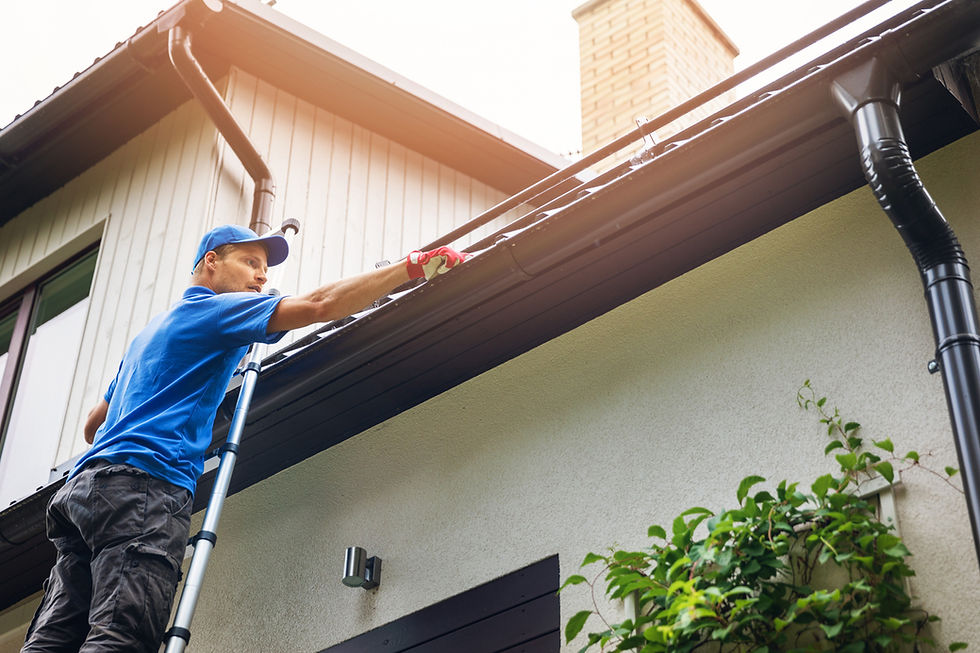
Safe cleaning means a stable ladder, gloves, eye protection, and a hose for flushing. Most insurance adjusters discourage homeowner work on gutters above ground-floor height; two-storey work is a legitimate professional call. Pro cleaning costs $150 to $300 for a typical two-storey Calgary home.
A complete cleaning how-to article is part of this cluster.
When to Bundle With Roof Replacement
If you're planning a roof replacement and your eavestroughs and downspouts are 15+ years old or show any failure signs, bundling them into the same project usually makes financial sense. Replacing the entire roof drainage system at the same time helps improve water management, reduces labour costs, and ensures every component works together.
Advantages of bundling:
Shared access scaffolding and crew time
Drip-edge and gutter alignment done correctly in one pass
Single warranty coverage across the system
Discount on combined linear-foot pricing (typically 5% to 10%)
When to keep them separate:
Existing eavestroughs are under 8 years old and undamaged
The budget can only support one project at a time
The two projects need to be sequenced across years for tax or cash-flow reasons
The bundling article in this cluster walks through the decision in more detail.
Frequently Asked Questions
How much do new eavestroughs cost in Calgary?
Most single-storey homes pay $1,200 to $2,000 for a complete replacement; two-storey homes typically run $2,000 to $3,500. Aluminum 5-inch K-style is the most common spec. Upgrades to 6-inch or steel add $3 to $6 per linear foot. Removal of old gutters and fascia repair, if needed, adds to the base price.
How long do aluminum eavestroughs last in Calgary?
20 to 30 years for typical aluminum, depending on hail exposure and maintenance. Calgary's three major hail seasons since 2020 have shortened the practical lifespan of many homes. Steel lasts 25 to 40 years but rusts at cut edges if maintenance is neglected.
Are gutter guards worth it in Calgary?
Micro-mesh guards reduce cleaning to once every 2 to 3 years and pay back over time for two-storey homes and properties with mature trees. They don't stop ice damming and don't eliminate cleaning entirely. Budget-tier foam and brush guards underperform in Calgary's debris mix.
Will my insurance cover hail damage to my eavestroughs?
Most Alberta homeowners' policies cover hail damage to gutters as part of the broader hail claim. Standalone eavestrough claims are rare; gutter damage is usually documented alongside roof damage. Aviva and a few other insurers have endorsements that cap or exclude eavestrough coverage on aging exteriors. Check your policy before assuming.
Can I replace just one section of eavestrough?
Yes, in some cases. Match the profile, gauge, and colour where possible. Aluminum K-style is widely standard, so cosmetic matching is usually achievable. If multiple sections fail within a few years, full replacement is more cost-effective than ongoing patches.
How do I prevent ice damming in my gutters?
The fix is in the attic, not the gutter. Add insulation to R-50+, ensure soffit-to-ridge ventilation is balanced, and seal attic bypasses (light fixtures, plumbing stacks). Heat cables in the gutter are a last-resort symptom manager. Ice and water shield under the shingles at the eaves is part of the same prevention package.
Should I replace my eavestroughs when I replace my roof?
If the existing eavestroughs are 15+ years old or showing failure signs, yes. Shared crew access and alignment accuracy save 5% to 10% versus separate projects. If gutters are under 8 years old and undamaged, keep them.

About Angel's Roofing: Angel's Roofing provides Calgary eavestroughs and downspouts throughout Calgary and surrounding areas, specializing in seamless aluminum and steel installations, downspout placement matched to Calgary drainage needs, and integrated eavestrough and roof system work for homeowners requiring trusted exterior protection.
Ready to protect your Calgary home's foundation with the right drainage system? Angel's Roofing helps Calgary homeowners safeguard their investment with seamless eavestrough installation, downspout layout designed for Calgary's clay soils, and 25+ years of integrated roof and exterior experience.
Contact us today at 403-569-2643 to book your eavestrough assessment or get a free quote on your Calgary installation.
Disclaimer: Roofing involves safety risks; consult licensed professionals for work beyond ground-level visual checks. Costs and specifications provided are estimates based on typical Calgary market conditions and may vary based on specific project requirements and current material pricing.


Comments