
Signs of Water Damage in Commercial Buildings


Quick Answer: The most reliable early signs of commercial roof water damage are ceiling stains that shift between weekly walks, drywall blistering, musty smells in HVAC supply air, ceiling tile sag, drains that pond beyond 48 hours, and rust streaks on rooftop unit curbs. Any of these symptoms means the underlying problem has been developing for weeks and warrants a roof inspection within 30 days.
A tenant calls about a stain. Or maintenance notes a musty smell near a server room. Or a routine walk-through finds a ceiling tile sagging. Each of these is the visible end of a problem that started weeks earlier on the roof, in the insulation, or at a flashing detail. When these signs point to an active or developing leak, commercial roof water damage repair can address the roof-system failure before the damage spreads further. Reading the symptoms correctly tells you whether you have a 30-day issue or a 24-hour emergency.
At a Glance
Most common first sign: Ceiling stain noticed by a tenant or maintenance walk
Time from roof failure to interior sign: Typically 2 to 8 weeks
Ponding water threshold for concern: Over 48 hours after rain or snowmelt
Active vs old stain test: New brown halo edge or spreading shape
HVAC musty smell: Often signals wet insulation in supply ductwork or roof assembly
Mould risk window: 24 to 48 hours of trapped moisture
Ceiling Stains and What They Mean
Ceiling stains are the symptom most property managers see first. The pattern reveals the source.
Round or oval stains with a defined dark ring indicate cyclical wetting and drying. The ring is mineral residue left after evaporation. Stains with three or four nested rings suggest months of intermittent leaking, typically from a flashing or penetration that fails during heavy rain and dries between events.
Diffuse stains without a clear edge indicate slow, continuous moisture migration. This pattern points to wet insulation that wicks moisture into the ceiling without enough volume to drip.
Stains that change shape between walks are active leaks. A photograph compared week-over-week tells you whether the stain is growing or static.
Stains that don't line up with the leak source are normal in commercial buildings. Water enters at one point in the roof membrane, travels along the underside of the deck or through insulation gaps, and emerges at the lowest point in the ceiling cavity. Tracing the stain back to the roof requires thermal imaging or pressure testing, not assumption.
Drywall Blistering, Sagging, and Ceiling Tile Failure
Past the stain phase, materials start to deform.
Drywall blistering shows up as bubbles in paint or texture, typically near a wall-ceiling junction or around a light fixture. The blistering means the gypsum core has absorbed moisture and the paper face is delaminating.
Sagging acoustic ceiling tiles indicate the tile has absorbed enough moisture to deform under its own weight. A sagging tile near an electrical fixture is a safety concern, not just a finish concern. The wet tile can drop onto tenants or equipment.
A bowed tee bar (the metal grid holding ceiling tiles) means the grid itself is taking load from wet insulation above. This is a structural concern, not cosmetic. The ceiling assembly can fail catastrophically when the bow exceeds a few centimetres.
Once materials deform, water has typically been present for weeks. The roof side of the problem started long before the visible symptom.

Musty Smell in HVAC Supply Air
The most underrated commercial water damage sign is a musty smell distributed through HVAC supply registers.
Calgary commercial HVAC systems often run supply ductwork through the roof assembly or just below it. When membrane failure saturates insulation around the duct, the supply air picks up the moisture odour and distributes it building-wide. The same mechanism distributes mould spores once they develop.
Tenants describe the smell as "old basement", "damp", or "musty". It is most noticeable in the morning when the HVAC first cycles on and the system pulls air through wet material.
When a musty smell coincides with a tenant complaint cluster, treat it as an urgent investigation, not a maintenance ticket.
Membrane and Roof Surface Symptoms
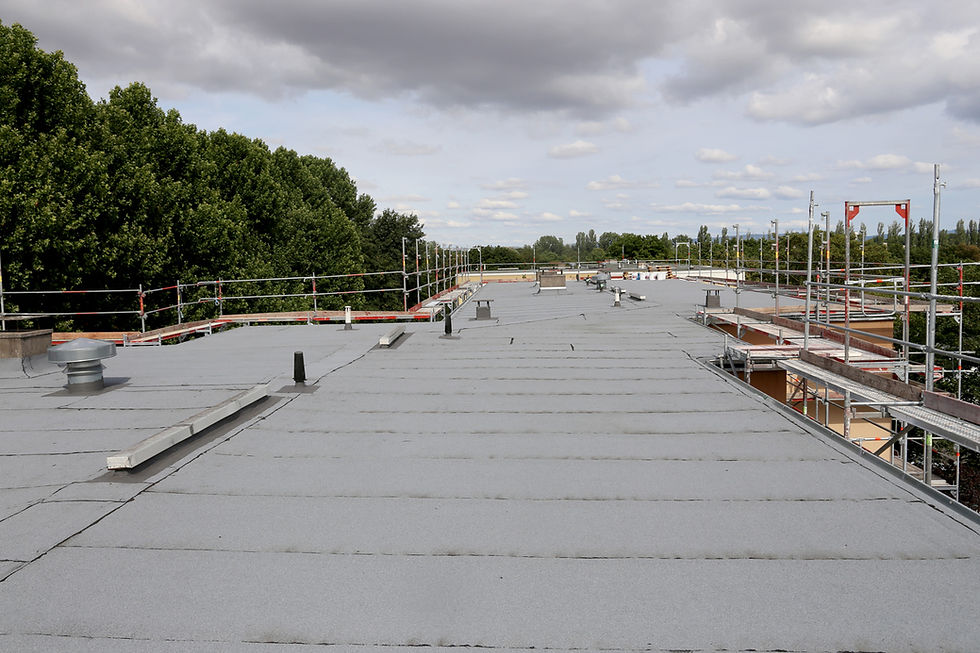
The roof side shows its own pattern of warning signs. Property managers walking the roof should look for:
Blistering on the membrane. Bubbles raised above the surrounding surface, ranging from coin-sized to plate-sized. Blisters indicate trapped moisture or air below the membrane. Walked-on blisters can rupture and create entry points.
Ridging. Visible lines running across the membrane surface, usually following insulation joints. Ridging indicates trapped moisture expanding and contracting with thermal cycling.
Fishmouthing. Open or partly open laps at seam edges, often raised in a fish-mouth shape. Fishmouths are direct entry points.
Exposed felt or scrim. UV degradation has worn through the surface coating, exposing the layer below. On TPO this looks like a yellowish patch; on SBS like a grey, fibrous patch.
Ponding water 48 hours after rain or snowmelt. Any standing water beyond this threshold is a problem, not a curiosity. Calgary's freeze-thaw turns ponding into accelerated damage.
Sealant cracking or pulling away. Sealants at curbs, terminations, and penetrations degrade under UV and freeze-thaw. Cracked or recessed sealant is a leak waiting to happen.
A walkthrough with a phone camera and a checklist captures most of these in under an hour for a typical 20,000 sq ft commercial roof.
Drain and Drainage Warning Signs
Drains and scuppers fail in predictable ways.
A drain that holds water 24 hours after rain is partially blocked. Beyond 48 hours, the drain is fully blocked, the drain is failing, or the slope to the drain has reversed.
A scupper with white mineral staining around the opening has been overflowing intermittently. The staining is left when water carrying calcium and other minerals dries on the metal or membrane.
A drain bowl filled with debris (leaves, gravel, asphalt granules) is a maintenance failure, not a roof problem. Twice-yearly drain cleaning prevents most of these issues.
Internal downspouts that develop wet spots on the interior wall below the roof level indicate a downspout joint failure inside the wall cavity. This is a serious finding because the leak is hidden inside building cavities and can run undetected for months.
Rooftop Equipment and HVAC Curb Symptoms
Rooftop units (RTUs) and other equipment introduce their own water damage pattern.
Rust streaks running down a curb indicate flashing failure at the curb-to-membrane joint.
The rust is from the curb's steel structure dissolving under prolonged wetting.
Sagging units mean the curb framing or insulation below has saturated and lost structural integrity. Sagging RTUs are a fall hazard and a structural concern.
Electrical issues on rooftop units (controls failing, condensers cycling abnormally, supply fan blowing wet smells) often trace back to water intrusion at the curb or through electrical conduits.
A rooftop unit that suddenly underperforms after a rainstorm is signalling water exposure. The HVAC service technician and the roofing vendor should both inspect.

Tenant Complaint Clusters
Signs of water damage in commercial buildings often appear first through tenant complaints rather than an obvious roof leak. A single tenant complaint is usually a single tenant issue. Three complaints from three units within a 30-day window, however, can indicate an envelope or roof problem that requires investigation.
Cluster patterns to watch for:
Complaints along one exterior wall (often points to parapet or wall-roof joint failure)
Complaints clustered under one mechanical curb (often points to HVAC curb flashing failure)
Complaints all from upper-floor tenants in a multi-storey building (points to roof, not ground-floor envelope)
Complaints all citing HVAC supply odour (points to insulation saturation in the roof assembly)
Treat cluster complaints as a roof investigation trigger, not a series of individual tickets.
Frequently Asked Questions
Why do ceiling stains move?
Water enters at one point in the roof and travels along the underside of the deck, through insulation, or along structural members until it finds a low point in the ceiling cavity. The stain appears where the water exits, which often is not directly below the entry point. Moving stains over time indicate water finding new exit paths as the assembly saturates further.
Can a stain be old water that already dried?
Yes. An old stain that hasn't changed in months may be from a single event that has since resolved or been repaired. The test is photographing the stain and re-checking in 2 to 4 weeks. If the shape, size, or colour intensity changes, the leak is still active.
Do all commercial leaks come from the roof?
No. Plumbing leaks, HVAC condensate, and envelope failures (wall systems, windows, parapet copings) all cause similar symptoms. A thermal scan from the roof side helps differentiate roof-sourced moisture from plumbing or envelope sources. Most experienced commercial roofing vendors will rule out other sources before quoting a repair.
How fast should I act on a musty smell with no visible stain?
Within 7 days. A musty smell without a stain typically means moisture is present in a hidden location (insulation, duct insulation, wall cavity) and has not yet saturated enough to surface visibly. By the time a stain appears, the issue has been developing for weeks longer.
What if the building has multiple symptoms at once?
Multiple symptoms in different building areas suggest either a systemic issue (drain capacity, multiple aged flashings, widespread sealant failure) or multiple coincident issues. A complete inspection of the entire roof, all penetrations, and all drains is warranted, not a series of point repairs.

About Angel's Roofing: Angel's Roofing provides Calgary commercial water damage repair throughout Calgary and surrounding areas, specializing in early-symptom diagnosis, thermal moisture scans, and written assessment reports for property managers requiring trusted protection of their assets and tenants.
Ready to investigate a suspect ceiling stain, musty smell, or membrane symptom on your building? Angel's Roofing helps Calgary property managers protect business continuity with on-site diagnostic inspections, drone and thermal imaging, written reports with photos, and 25+ years of Calgary commercial roofing experience.
Contact us today at 403-569-2643 to book a commercial water damage assessment.
Disclaimer: Roofing involves safety risks; consult licensed professionals for work beyond ground-level visual checks. Costs and specifications provided are estimates based on typical Calgary market conditions and may vary based on specific project requirements and current material pricing.


Comments